All case studies

Polyamyna

Durability at Every Touchpoint.

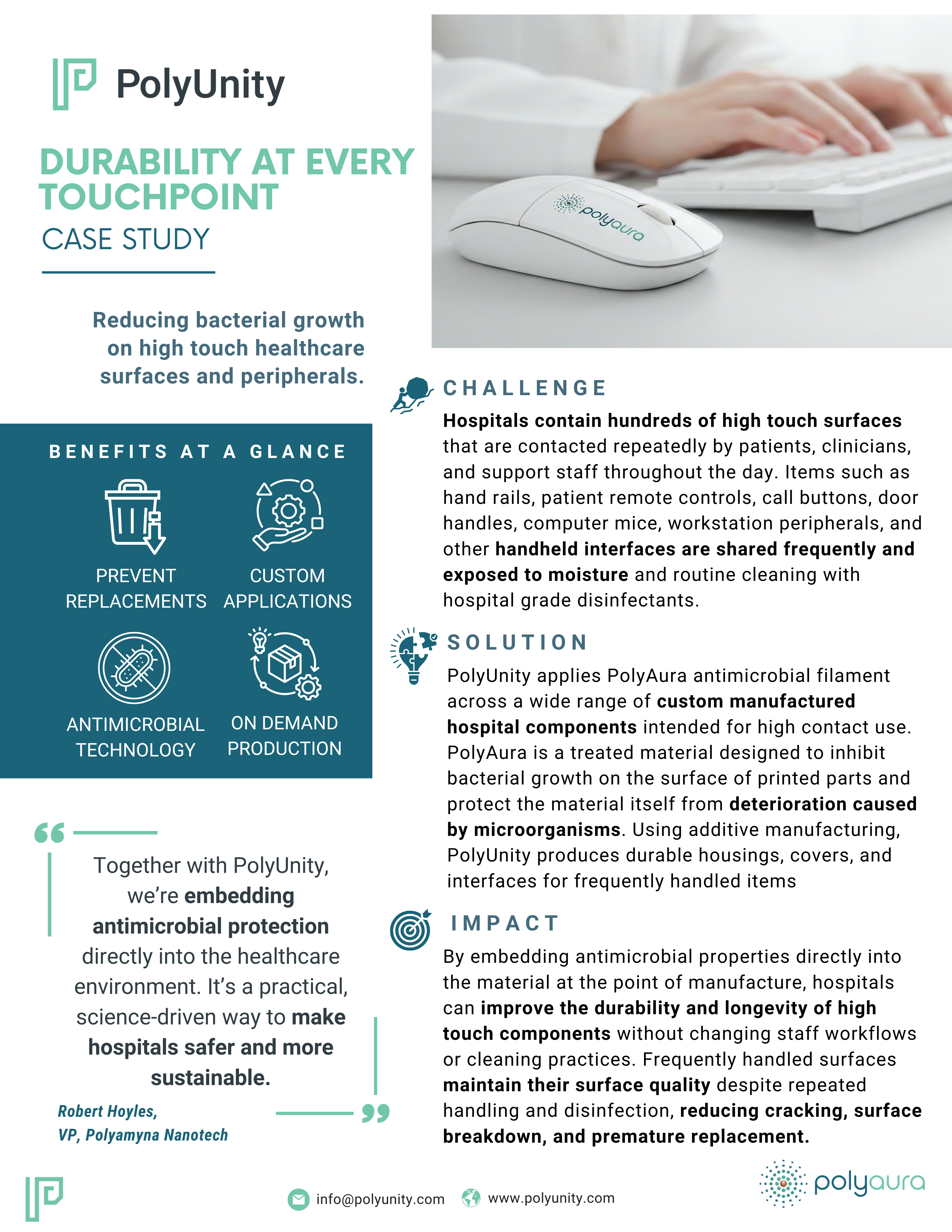
PolyUnity applies PolyAura antimicrobial filament to custom manufactured hospital components, reducing bacterial growth on high touch healthcare surfaces and peripherals while improving durability.

PolyAura logo

Reducing bacterial growth on high touch healthcare surfaces and peripherals.

Challenge

Hospitals contain hundreds of high touch surfaces that are contacted repeatedly by patients, clinicians, and support staff throughout the day. Items such as hand rails, patient remote controls, call buttons, door handles, computer mice, workstation peripherals, and other handheld interfaces are shared frequently and exposed to moisture and routine cleaning with hospital grade disinfectants.

Solution

PolyUnity applies PolyAura antimicrobial filament across a wide range of custom manufactured hospital components intended for high contact use. PolyAura is a treated material designed to inhibit bacterial growth on the surface of printed parts and protect the material itself from deterioration caused by microorganisms. Using additive manufacturing, PolyUnity produces durable housings, covers, and interfaces for frequently handled items.

Impact

By embedding antimicrobial properties directly into the material at the point of manufacture, hospitals can improve the durability and longevity of high touch components without changing staff workflows or cleaning practices. Frequently handled surfaces maintain their surface quality despite repeated handling and disinfection, reducing cracking, surface breakdown, and premature replacement.

“Together with PolyUnity, we’re embedding antimicrobial protection directly into the healthcare environment. It’s a practical, science-driven way to make hospitals safer and more sustainable.”

— Robert Hoyles, VP, Polyamyna Nanotech

Durability at Every Touchpoint case study